Daniele
Fedeli

PhD student in Theoretical Physics at the Rudolf Peierls Centre, University of Oxford

Clarendon Scholar

I am supervised by Professor Michael Barnes and work on plasma turbulence in stellarators. The idea of my project is to understand how turbulence carries heat out of a magnetically confined plasma, and how this depends on the three-dimensional shape of the magnetic field.

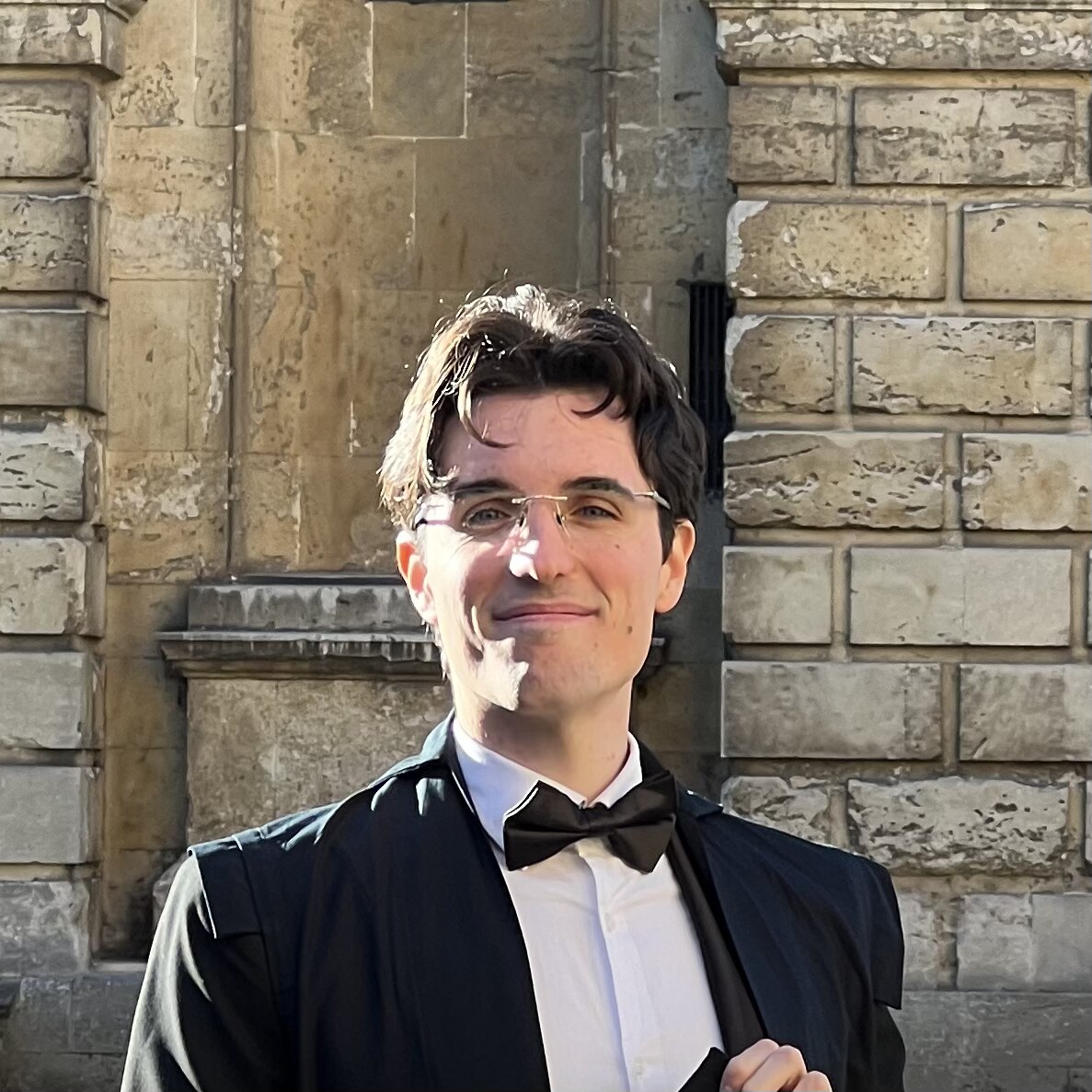
Daniele Fedeli in Oxford

Academic background

Map of Europe showing the journey from Rome to Pisa by train, then by air to London Heathrow for Oxford Rome Pisa Oxford
Rome → Pisa → Oxford© OpenStreetMap contributors

Rome

2002 — 2021

I was born in Rome in 2002. My interest in mathematics and physics began in my final year of middle school. From then on, I enjoyed taking part in Olympiads—even when the results were mixed.

I attended Liceo Scientifico Augusto Righi, where I met my first community of future mathematicians and physicists. Many of them are still close friends.

Pisa

2021 — 2026

I moved to Pisa for university, studying physics at the University of Pisa and the Scuola Normale Superiore. There, I could finally devote myself full-time to the subjects I enjoyed most.

2021 — 2024
BSc in Physics, University of Pisa · 110/110 cum laude
2024 — September 2026
MSc in Physics, University of Pisa · 110/110 cum laude
2021 — 2026
Diploma di Licenza in Physics, Scuola Normale Superiore
Università di PisaScuola Normale Superiore

Oxford

2025 — today

I first moved to Oxford for six months in October 2025. I worked with Alex Schekochihin and Plamen Ivanov on my master’s thesis, studying coherent structures in plasma turbulence (the PDF is in the University of Pisa archive , under embargo until 2029).

Among the options available to me for the PhD, I chose to stay in Oxford. Since October 2026, I have been working with Michael Barnes, Daniel Kennedy and Richard Nies on plasma turbulence in stellarators. My PhD is supported by a Clarendon Scholarship and by the Max Planck Institute for Plasma Physics in Greifswald.

October 2026 — present
PhD in Theoretical Physics
University of OxfordClarendon FundMax Planck Institute for Plasma Physics

Teaching, representation and awards

Teaching

  1. Graduate Mentor and Graduate Teaching Assistant

    Merton College, Oxford

    Mark Statistical Mechanics problem sheets for eight second-year students and act as their mentor, offering support for their studies.

  2. Physics Olympiad training camp

    Scuola Normale Superiore

    Designed and delivered two advanced problem-solving lectures for the camp’s 24 selected high-school students.

  3. Physics Olympiad preparation courses

    Liceo A. Righi, Rome

    Taught two courses of weekly theory and problem-solving sessions to a few students, some of whom reached the national finals.

  4. University admissions tutoring

    Individual tutoring

    Helped students prepare for university entrance examinations in scientific subjects.

Representation

  1. Student representative, Board of Governors

    Scuola Normale Superiore

    Elected for two terms; worked on the Board’s routine business and, among much else, on revising the regulations of the Students’ Assembly and of college life.

  2. Founder of Oltre and member of the School Council

    Liceo A. Righi, Rome

    Founded and led Oltre, an association of about twenty members that organized events and handled student representation for the whole school; in the same spirit, represented students on the School Council.

Awards

  1. PLANCKS

    Silver medal

  2. International Physics Olympiad

    Bronze medal

  3. Italian Physics Olympiad

    Gold medal

  4. Italian Mathematics Olympiad

    Silver medals

Full CV · PDF

Magnetic confinement in stellarators

  • Magnetic surfaces
  • Non-planar coils
  • Planar coils
  • Vacuum vessel

Magnetic surfaces

A plasma is a gas of electrons and ions. In a magnetic field, these particles gyrate around field lines and can move along them. In the core of a stellarator, the field lines wind around nested magnetic surfaces. This geometry forms the basis of magnetic confinement.

Nested magnetic surfaces in the core of Wendelstein 7-X, viewed in three dimensions.

Coils and vacuum vessel

External coils produce this three-dimensional field. In Wendelstein 7-X, 50 non-planar and 20 planar coils allow its geometry to be controlled. The vacuum vessel encloses the plasma and separates it from the surrounding atmosphere; the cutaway shows how its shape follows that of the confined volume.

Wendelstein 7-X vacuum vessel surrounded by the full set of non-planar and planar coils.

Plasma cross-section and transport

The cross-section shows the nested magnetic surfaces. The field restricts transport across these surfaces, but does not eliminate it. Collisions and turbulence can carry particles and energy outwards. Understanding these losses is essential to assessing how effectively the plasma retains heat.

Cross-section of the Wendelstein 7-X plasma volume, showing the contours of nested magnetic surfaces.

Odds and ends

Plasma physics galaxy

An interactive map of plasma physics, with illustrative stellar levels.

Open the galaxy

Master’s thesis

Coherent Structures in Sheared Ion-Temperature-Gradient Plasma Turbulence

Research with Alex Schekochihin and Plamen Ivanov for my MSc at the University of Pisa.

PDF under embargo until 21 September 2029. The record and the abstract are public; if you would like to read the thesis sooner, write to me.

University of Pisa ETD record
Stellarators, explained

Get in touch

For questions about my research, teaching or collaborations.