Strikes as
Sequences of Interaction: The American Strike Wave of 1886
Social Science History, vol. 26, no. 3, 2002, pp. 583-617;
DOI 10.1017/S0145553200013092
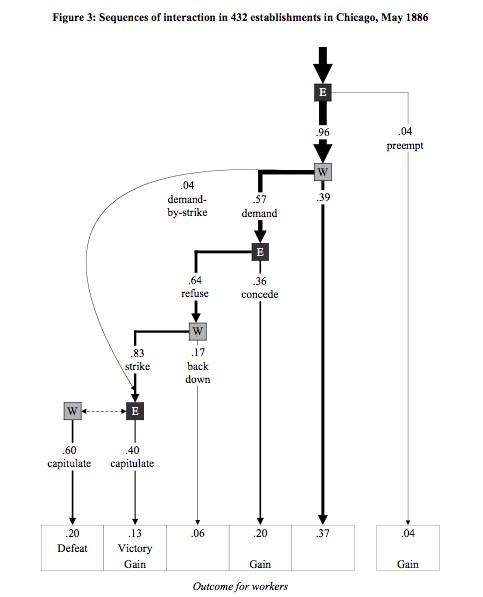 This article analyzes strikes as sequences of interaction between workers and employers, rather than as events determined by exogenous economic and political conditions. Drawing on a survey of 432 Chicago firms conducted by the Illinois Bureau of Labor Statistics, it reconstructs the interactions surrounding the American strike wave of May 1886, including demands, concessions, strikes, and subsequent counterattacks. The analysis shows that many conflicts never resulted in strikes, while many apparent strike “victories” were later reversed by employers. By tracing series of connected interactions, the article reveals a dramatic reversal of expectations during May 1886, as workers’ initial optimism was revealed to be unrealistic. The findings demonstrate the importance of diachronic processes in understanding class conflict and collective action.
(Awarded biennial prize for the best article by a graduate
student published in Social Science History,
2002-3.)

Michael Biggs, Department of Sociology, University
of Oxford