|
|
|
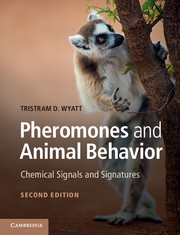 Pheromones and animal behavior Pheromones and animal behavior
TD Wyatt (2014) (2nd edition)
Winner, Best
Postgraduate Textbook Prize, Society of Biology 2014. 
The judges wrote:
"Revised and extended since the first edition, this
splendid, comprehensive resource covers both classic ideas in
the field of chemical communication as well as recent advances,
such as the surprising discovery that the chemoreceptors of
insects and vertebrates evolved independently. ... more"
From the blurb: "Pheromones and other kinds of chemical
communication underlie the behavior of all animals. Building on
the strengths of the first edition, widely recognized as the
leading text in the subject, this is a comprehensive overview
of how pheromones work. Extensively revised and expanded to
cover advances made over the last ten years, the book offers a
thorough exploration of the evolutionary and behavioral
contexts of chemical communication along with a detailed
introduction to the molecular and neural basis of signal
perception through olfaction. At a time of ever increasing
specialization, Wyatt offers a unique synthesis, integrating
examples across the animal kingdom. A final chapter critically
considers human pheromones and the importance of olfaction to
human biology. Its breadth of coverage and readability make the
book an unrivaled resource for students and researchers in a
range of fields from chemistry, genetics, genomics, molecular
biology and neuroscience to ecology, evolution and behavior."
2014 | Paperback (Hardback) | ~420 pages ; ISBN 9780521130196 Cambridge University Press
in USA
Endorsements of the second edition:
'Tristram Wyatt's Pheromones and Animal Behavior
takes us on an interdisciplinary voyage along one of the most
ancient communication channels. He explores, in depth, how
chemical signals and signature mixtures shape social
interactions, and why. I enjoyed his writing style, which also
makes the book accessible to non-specialists. This excellent
second edition is heavily revised and enriched. It unravels
some of the mysteries of the world of pheromones, explaining
what they are, their origins, functions, evolution, and the
communication purposes they serve in a large variety of
animals. Wyatt takes us through a well-judged range of examples
of some of the amazing chemical communication strategies, from
ants right up to the scent of human attraction. The book is
far-reaching, inspiring, and brilliantly illustrated.'
- Patrizia d'Ettorre, University of Paris 13, Sorbonne Paris
Cité
'This thoroughly modern revision of the classic first edition
is an amazing journey through the landscape of pheromones.
Tristram Wyatt engagingly covers a vast territory, deftly
condensing thousands of important academic papers into a
lively, informative, and richly illustrated book. Everything
from insects to the possibility of sexy secretions from humans
is covered from the points of view of neuroethology, chemistry,
molecular biology, and more. The book is a must-read for any
undergraduate or graduate student or working scientist
interested in a singular comprehensive resource on this
fascinating topic.'
- Leslie B. Vosshall, Rockefeller University, New York
'By highlighting the power of pheromones, this book illustrates
how chemical signals rule the animal kingdom. Wyatt
challengingly dissects the phenomena derived from chemical
communication at molecule, receptor, and neural levels, based
on an enormous range of information from past and recent
literatures … I like his point that the importance of
chemistry in understanding pheromone action should be
re-emphasized, given the recent trends in science that rely too
much on molecular biology and neuroscience techniques. This
book can be used as a textbook for students but also for
researchers, as … Wyatt gives many valuable insights
that direct readers into the research. I cannot help thinking
that I will cite this book in all research papers that I will
publish in the future. The book is too perfect and insightful
to imagine that another new edition would publish while I am
still alive.'
- Kazushige Touhara, University of Tokyo
'Understanding other animals is a matter of seeing the world
through their eyes - but awkwardly, for us humans, most animals
experience the world primarily through their noses (or
equivalent), and to 'see' the world through another organism's
nose requires the greatest ingenuity. Remarkably, the fruits of
just such enthralling ingenuity is exactly what Tristram Wyatt
delivers to us in this rivetingly interesting book, which
synthesises cutting-edge research from biochemistry to
behavioural ecology, demonstrating en route that what is
eye-openingly fascinating can also be life-changingly useful.
As Wyatt observes, we live in a chemical world, and this
lucidly written and intelligently illustrated book sets the
nostrils aquiver as we catch the scent of a new reality.'
- David W. Macdonald, Wildlife Conservation Research Unit,
University of Oxford
Reviews of the first edition:
"Pheromones are by far the most important signals used by
organisms of all kinds. Wyatt's book is an excellent text and
review: up-to-date, comprehensive, balanced, detailed, clearly
written, and nicely illustrated."
- Edward O. Wilson, Harvard
"Wyatt demonstrates an impressive grasp of the literature
and has written a most enjoyable and informative textbook (one
that I read non-stop). ... The introductory chapter, 'Animals in a chemical world' is the best
overview ofpheromones that I have ever come across, and worth
reading by itself if you have no time or interest to read the
entire book. ... It is no exaggeration that, as the teaser of
Wyatt's book claims,'[this book] is the first to cover the
whole animal kingdom at this level for 25 years'."
- Peter Mombaerts in Nature Neuroscience (2004)
7:201
"Wyatt's book is a remarkable summary of a growing and
exciting field of discovery. ... A particular strength is the
concise presentation of the theoretical background to each
major topic, enabling readers unfamiliar with the topic to
appreciate fully how the pheromones under scrutiny have
evolved. ... For those interested in olfaction, this book is
excellent both as an introduction to the field and as a
refresher of a vast, growing and exciting literature."
- S. Craig Roberts in Animal Behaviour (2003)
66:804-805
More and full reviews of the book are here
|
|
| Pheromone news |
2nd edition book
contents
- Animals in a chemical world;
- Methods for identifying and studying
semiochemicals;
- Pheromones, chemical cues and sexual selection;
- Coming together and keeping apart;
- Territorial behavior, pheromones and signature
mixtures;
- Semiochemicals and social organization;
- Pheromones and recruitment communication;
- Fight-or-flight: alarm pheromones and cues;
- Perception and response to chemical
communication: from chemosensory receptors to
brains, behavior & development;
- Finding the source;
- Breaking the code;
- Using semiochemicals;
- On the scent of human attraction;
Appendix: An introduction to chemical terms for
non-chemists
References
|
|