Jennifer L. Castle
Magdalen College, Oxford, OX1 4AU
E-mail: jennifer.castle@magd.ox.ac.uk
Tel: +44 (0)1865 276067
Google Scholar Homepage
|
|
News
A forecast-error taxonomy facing multiple shifts is in press at Econometrics and Statistics.
David Hendry, Andrew Martinez and I have submitted written evidence to the Parliamentary Select Committee on The OBR: 15 years on.
The `Climate Kuznets Curve': A Critique has been published in Energy Economics.
Forecasting Climate Change Using a Multivariate Cointegrated System has been published in Oxford Bulletin of Economics and Statistics.
I am a Member of the Stekler Forecasting Program, at the Center for Economic Research at George Washington University.
Could the Bank of England have avoided mis-forecasting UK inflation during 2021—24?, has appeared in International Journal of Forecasting.
A Novel Approach to Forecasting After Large Forecast Errors has now been published in the Journal of Forecasting.
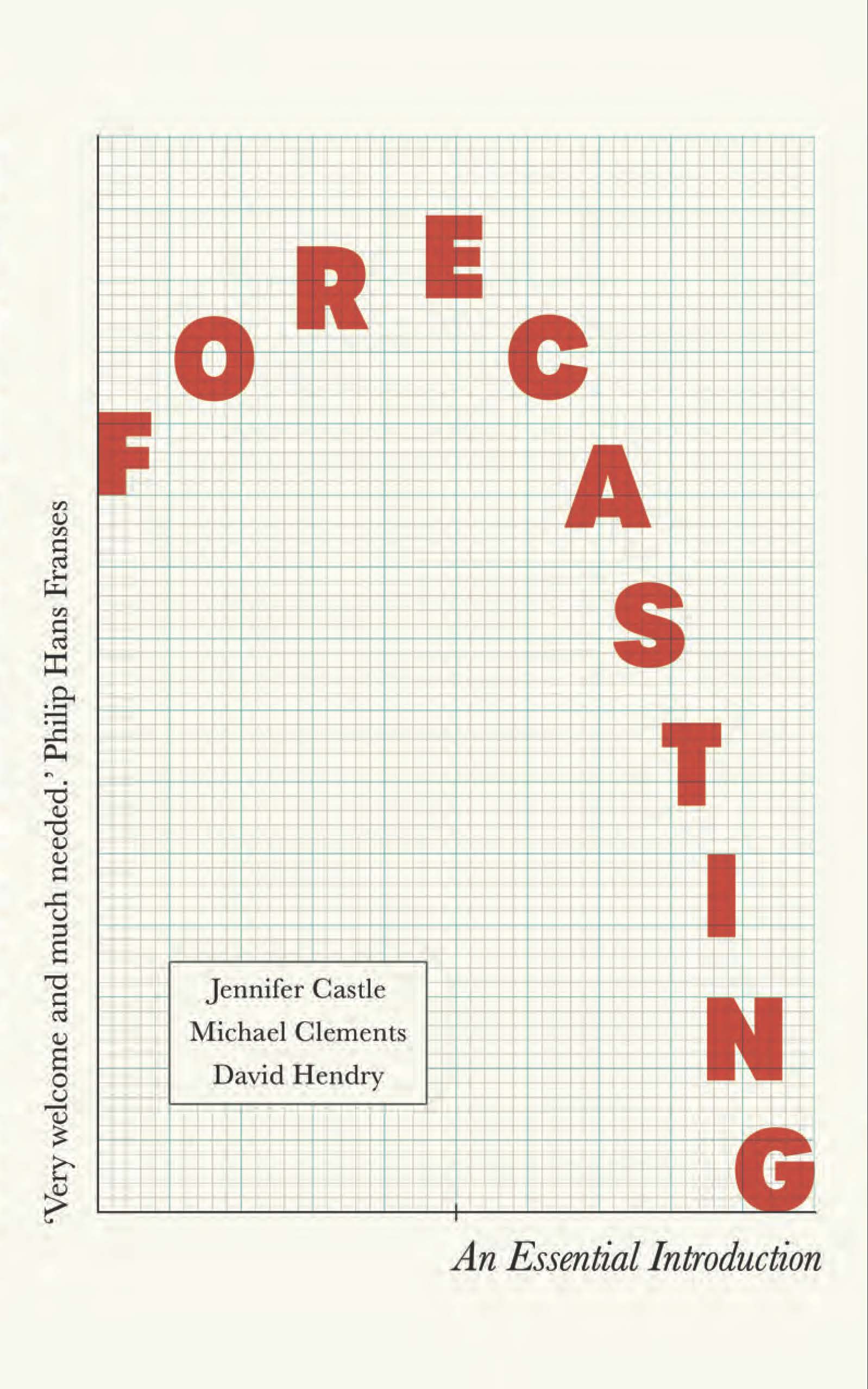
Making accurate predictions about the economy has always been difficult, as F. A. Hayek noted when accepting his Nobel Prize in economics, but today forecasters have to contend with increasing complexity and unpredictable feedback loops. In this accessible and engaging guide, David Hendry, Michael Clements, and Jennifer Castle provide a concise and highly intuitive overview of the process and problems of forecasting. They explain forecasting concepts including how to evaluate forecasts, how to respond to forecast failures, and the challenges of forecasting accurately in a rapidly changing world.
Topics covered include: What is a forecast? How are forecasts judged? And how can forecast failure be avoided? Concepts are illustrated using real-world examples including financial crises, the uncertainty of Brexit, and the Federal Reserve s record on forecasting. This is an ideal introduction for university students studying forecasting, practitioners new to the field and for general readers interested in how economists forecast.
The book is available from Yale University Press.
See Climate Econometrics for a blog about the book and The Enlightened Economist for a review.
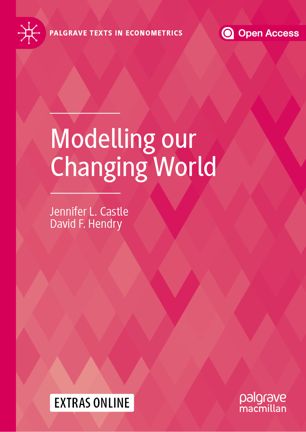
The evolution of life on Earth - a tale of both slow and abrupt changes over time - emphasizes that change is pervasive and ever present. Change affects all disciplines using observational data, especially time series of observations. When the dates of events matter, so data are not ahistorical, they are called non-stationarity denoting that some key properties like their means and variances change over time. There are several sources of non-stationarity and they have different implications for modelling and forecasting.
This open access book focuses on the concepts, tools and techniques needed to successfully model ever-changing time-series data. It emphasizes the need for general models to account for the complexities of the modern world and how these can be applied to a range of issues facing Earth, from modelling volcanic eruptions, carbon dioxide emissions and global temperatures, to modelling unemployment rates, wage inflation and population growth.
The book is open access and is available from Palgrave Macmillan.